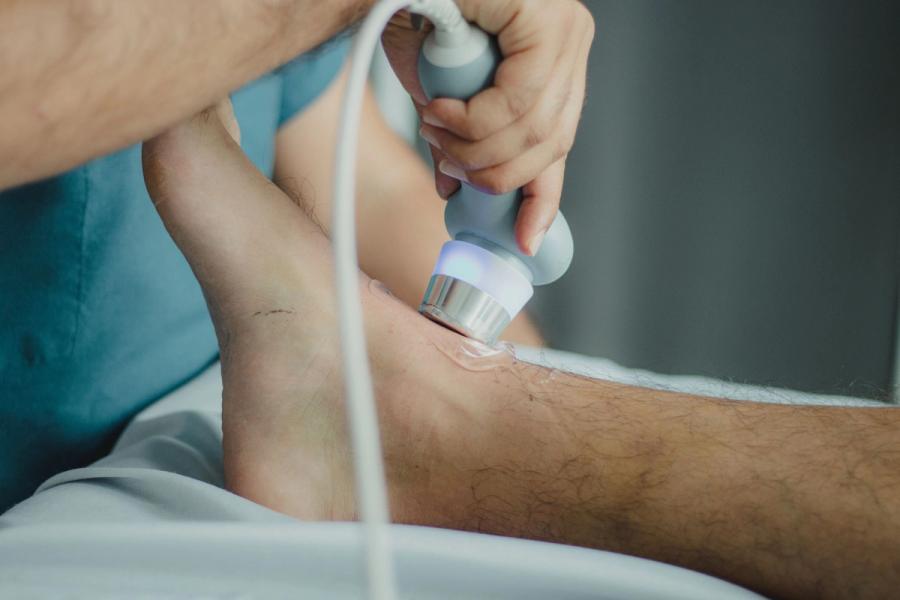
Diagnostic ultrasound at a physical therapy clinic is real-time imaging of soft tissue, including muscles, tendons, ligaments, and the area around joints, done right in the treatment room. It can help a physical therapist see what's happening beneath a sore spot and watch those structures as you move, which may make a treatment plan more precise.
At Omnia Wellness & Recovery in Superior, WI, diagnostic ultrasound is offered in the clinic with no referral and no radiation. Here is a plain-language look at what it shows, where it falls short, and when it's actually worth using.
What does diagnostic ultrasound show?
Diagnostic ultrasound shows soft tissues close to the surface of the body, such as muscles, tendons, ligaments, and the tissue around joints. A small handheld probe sends sound waves into the area, and the echoes create a live image on a screen. Because the picture updates in real time, a clinician can see not just how a structure looks at rest but how it behaves when you bend, reach, or contract a muscle.
Depending on the area and the situation, ultrasound may help a clinician look for:
- Tendon changes, such as thickening, irritation, or possible signs of a tear
- Muscle injuries, like a strain or an area of disrupted fibers
- Ligament injuries near the surface, such as around the ankle or elbow
- Fluid or swelling around a joint, tendon, or bursa
- How tissues glide and move during motion, which a still image can't capture
- Side-to-side comparison, since the healthy side can be scanned in the same visit
An image is only one piece of the picture. Findings on ultrasound are interpreted alongside your history, your symptoms, and a hands-on movement exam, because what shows up on a screen doesn't always match what you feel.
What can't ultrasound show?
Ultrasound cannot see through bone, so it has real limits for anything deep inside a joint or behind a bony structure. Sound waves bounce off bone, which means the inside of a bone and structures tucked deep within a joint are often hard to view clearly.
- Fractures and bone problems are usually better evaluated with X-ray
- Deep joint structures, such as parts of the knee meniscus or the inside of the hip joint, are often better seen on MRI
- The spinal cord, nerves deep in the spine, and disc problems are generally outside what ultrasound can assess well
- Image quality can vary with body size, tissue depth, and the skill of the person scanning
If something on an exam or scan suggests a problem that needs a different kind of imaging or a physician's evaluation, a good physical therapist will tell you and point you in the right direction. Ultrasound in a PT clinic is a tool to guide care, not a replacement for every other test.
When is diagnostic ultrasound helpful in physical therapy?
Diagnostic ultrasound tends to be most helpful when it's unclear which soft-tissue structure is causing pain, or when a closer look could change how treatment is planned. Not every patient needs a scan, and many common problems can be assessed well with a careful history and movement exam alone.
Situations where a scan may add useful information include:
- Pain that isn't improving as expected, where a second look may help explain why
- Several possible pain sources in one area, such as the front of the shoulder, where tendons and other tissues sit close together
- Tendon pain in places like the Achilles, patellar tendon, elbow, or rotator cuff
- Sports injuries where an athlete and clinician want more information before progressing training
- A suspected muscle strain where the size and location of the injury may shape how the plan is paced
For athletes, this can fit naturally into return-to-sport planning. Omnia Wellness & Recovery offers physical therapy for athletes and injury prevention and recovery programs, and you can browse the full list of services to see how they fit together.
How is ultrasound different from an X-ray or MRI?
Ultrasound differs from X-ray and MRI mainly in what it can see, where it's done, and whether it captures movement. Each test has strengths, and they often complement each other rather than compete.
Ultrasound
- Real-time, moving images of soft tissue near the surface
- No radiation
- Can be done in the clinic during a physical therapy visit
- Limited view of bone and deep joint structures
X-ray
- Best known for showing bones, fractures, and joint spacing
- Uses a small amount of radiation
- Usually done at a separate imaging location
- Shows soft tissue poorly
MRI
- Detailed images of both soft tissue and deep structures
- No radiation, but usually requires a separate appointment and a referral
- Images are still, so movement isn't captured
What happens during a diagnostic ultrasound at Omnia Wellness & Recovery?
A diagnostic ultrasound at Omnia Wellness & Recovery in Superior, WI is done in the clinic as part of a one-on-one visit with a Doctor of Physical Therapy. The Doctors of Physical Therapy at Omnia Wellness & Recovery are Blake Radtke, DPT, and Emily Holter, DPT, DN, and you can meet Emily Holter to learn more about her orthopedic background.
A scan works best when it has a clear purpose, so it usually fits into a visit that looks something like this:
- You talk through your symptoms, history, and goals.
- The physical therapist checks how you move, what's tender, and what reproduces your pain.
- A water-based gel is applied to the skin, and the probe is moved gently over the area.
- You may be asked to move the joint or tighten a muscle so tissues can be seen in action.
- The findings, together with your exam, can help pinpoint the problem and guide a more precise treatment plan.
Diagnostic ultrasound is generally painless, though pressing over an already sore area can feel tender. Wear comfortable, loose clothing that gives easy access to the area, such as shorts for knee or hip concerns.
Because ultrasound requires the probe on your skin, it happens in person at 1308 Tower Ave in Superior. Some other parts of care, such as exercise guidance and follow-up conversations, may be possible through a virtual visit. If you're curious about that side of things, read what a virtual physical therapy visit looks like.
Do you need a referral for diagnostic ultrasound?
No referral is needed for diagnostic ultrasound at Omnia Wellness & Recovery. You can book directly, and the findings are considered alongside a physical therapy evaluation to help guide your plan.
Omnia Wellness & Recovery serves Superior and Duluth (the Twin Ports) in person, with virtual visits available across Minnesota and Wisconsin. If you've been wondering whether a closer look at a nagging tendon, muscle, or joint problem would help, the simplest next step is a conversation.
Talk to a DPT: book an appointment online, or call (218) 499-0806. Bring your questions, and you'll get a straight answer on whether ultrasound makes sense for you.
Frequently asked questions
Does diagnostic ultrasound hurt?
Diagnostic ultrasound is generally painless. You'll feel cool gel and light pressure from the probe, and an area that's already sore may feel tender while it's being scanned.
Do I need a doctor's referral for ultrasound at Omnia Wellness & Recovery?
No. Omnia Wellness & Recovery offers diagnostic ultrasound in the clinic with no referral needed. You can book online or call (218) 499-0806.
Can ultrasound replace an MRI?
Not always. Ultrasound is useful for soft tissue near the surface and for watching tissue move, but it can't see through bone or show deep joint structures well. Some problems still need an MRI or X-ray.
Does diagnostic ultrasound use radiation?
No. Ultrasound uses sound waves, not radiation, to create images.
Can I get diagnostic ultrasound during a virtual visit?
No. Ultrasound requires a probe on your skin, so it's done in person at the Superior, WI clinic. Some other parts of your care may be possible through a virtual visit.